
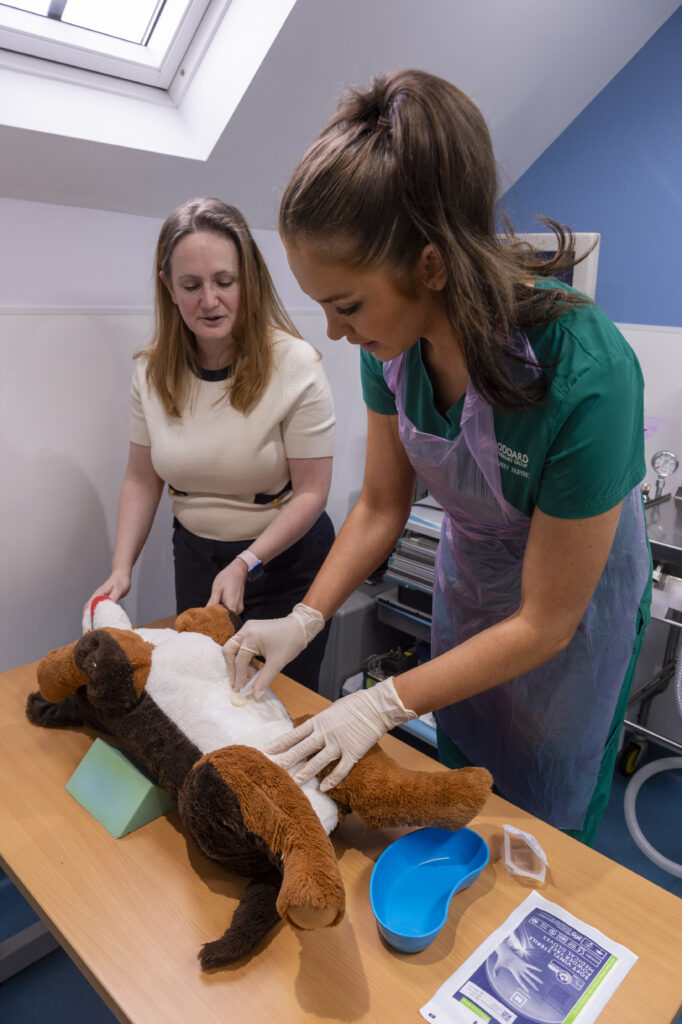
To become a qualified and recognised Veterinary Care Support (VCS) Assistant. A VCS assistant plays a critical role in the day-to-day smooth running of a practice, and the care of patients and responsibilities can include:
- Patient care – providing food, water, grooming, cleaning and the administering of oral medications.
- Operating theatre duties, including pre- and post-operative care.
- Ensuring biosecurity procedures are followed.
This course will equip you with the skills and knowledge for a career as a Veterinary Care Support Assistant and results in a stand-alone qualification.
You’ll become an apprentice, both with us and your practice and will be funded by the Government’s apprenticeship scheme. The value of available funding will be assessed for each learner on an individual basis.
Course topics include basic anatomy and physiology, infection control, animal health, pharmacy, administration of oral medication, first aid, veterinary care support and bereavement. Key modules include:
Legislation and safe working practices
This module is designed to develop the essentials of maintaining and developing personal performance within a veterinary care environment.
Animal health and welfare
Includes identifying problems with animals’ health and welfare, first aid, preventative and emergency healthcare. Providing care appropriate to species, lifestage and individual animal including care of coat, skin, scales, plumage and feet to ensure good health and appearance.
Delivering great customer experience (internal and external) in line with workplace policies and procedures.
Animal environment and accommodation
Includes hygiene, biosecurity, quarantine, isolation and infection control procedures.
Introduction to Animal anatomy and physiology
Includes basic anatomy and physiology. Basic reproduction and obstetrics, reproductive behaviour, including neutering.
Introduction to patient care
How to safely approach, handle, restrain and move animals. Feeding, watering, basic nutrition, storage of and characteristics of foodstuffs. Characteristics and behavioural traits of common breeds and species.
Veterinary care support
Includes dealing with potential and actual emergency situations, pre- and post-operative and inpatient care and patient monitoring. Common medical, behavioural and surgical care requirements.
Principles of care and clinical parameters of common species seen in a veterinary environment, diagnostic care/tests/X-rays positioning and exposing, end-of-life care for pets and providing support for the owner. How to deal with emotional clients and the importance of the human-animal bond.
There are no minimum entry requirements for you to apply for this course. Apprentices may however be required to work towards Maths and English Level 1 and 2 while on the course.
The course duration is 13-16 months.
This course is delivered through a blended learning approach with a mixture of self-directed study and tutor-led lessons. Practice skills are supported in the face-to-face taught programme and through teaching and supervised experience in a veterinary practice. You’ll need to successfully complete:
- Internal practical assessments.
- Internal examination assessments.
- Practical assessments / handbooks.
- Written assignments.
- Your portfolio.
The college day starts at 9.30am and finishes at 4.00pm, with weekly assessments set. There is a 30-minute lunch break as well as two 15-minute breaks throughout the day. College days may be delivered either online, in person or through self-directed study to allow you flexibility where appropriate.
In addition to work and College attendance commitments, you should expect to set aside a certain amount of your own time to study for your qualification (approximately two to four hours per week). Examples include:
- Completion of your portfolio.
- Learning of definitions.
- Self-directed study sessions.
- Use of e-learning platform.
- Uploading of skills evidence.
- Revision for formative monthly revision tests.
- Weekly completion of reading journal and monthly off-the-job hours.
We routinely exceed the national average for pass rates by 12%.
After successfully completing the course, you’ll hold a nationally recognised qualification as a Veterinary Care Support Assistant. You’ll have gained valuable knowledge that could lead to a variety of animal-based careers, such as working in kennels or a cattery, with animal charities, pet shops or continuing to develop experience in different aspects of veterinary practice.
You may wish to use your qualification and experience to progress to a Level 3 Diploma in Veterinary Nursing.